

Sponsored Weekly Spotlight. Suprmind booked a paid Featured Week for the week of 19 October 2026. This article was published on 8 November 2026. It draws on the founder-edited directree listing and Suprmind's public documentation. We haven't tested the product's answer accuracy or measured time savings.
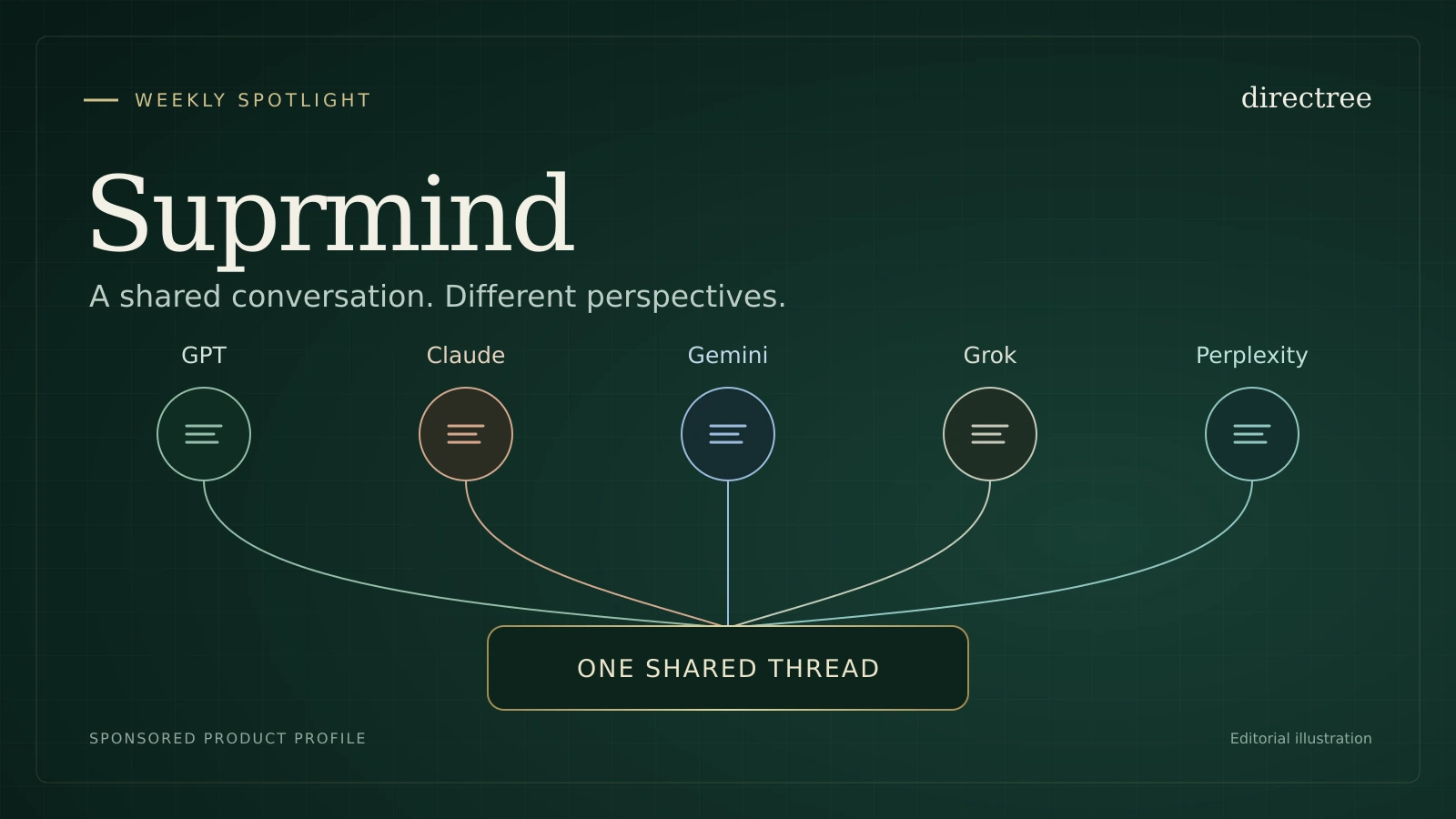
Suprmind brings different AI models into a shared conversation, with tools for discussing a question and turning the discussion into a document. Founders and analysts can keep their questions, supporting material and the models' arguments in that thread.
If you've ever copied an answer from one AI chat into another to ask for a second opinion, you'll recognise the workflow. You become responsible for carrying the context between them. When an assumption changes, you have to decide which conversations need updating.
Suprmind's founder-edited listing describes a platform built around GPT, Claude, Gemini, Grok and Perplexity.
How the shared conversation works
According to Suprmind's AI Boardroom documentation, models responding in Sequential mode receive the original question and earlier responses in the thread. A later answer can address an argument that another model has already made.
You can also use mentions to direct a follow-up question to a particular model.
A recommendation might depend on a customer segment you haven't validated, or a suggested deadline might assume more engineering capacity than you have. When a model challenges that assumption, you can examine it in the same thread.
The shared context also makes it important to inspect the reasoning. Several models agreeing in the same thread doesn't establish that the underlying claim is correct. Keep the original evidence available and check the claims that would change your decision.
Choose how the models discuss the question
Suprmind describes several approaches on its product overview:
- Sequential: models contribute in turn, with access to the earlier discussion.
- Super Mind: models respond in parallel, followed by a synthesised answer.
- Debate: models argue assigned positions and respond to counterarguments.
- Red Team: models examine a plan for weaknesses from different angles.
An open research question may benefit from Sequential mode. A proposal with a clear alternative gives Debate something specific to examine. A plan that's nearly ready to execute gives Red Team a defined set of assumptions to challenge. Access to these modes depends on the plan.
Carry the discussion into a usable document
A long conversation can leave the important decisions buried between suggestions. Suprmind's Scribe is described as a live sidebar that collects decisions, insights, actions, themes and disagreements while the thread develops.
Before exporting, check whether an unresolved objection has been recorded, whether a tentative idea has become a firm decision, and whether the proposed next steps match what you actually agreed to do.
The separate Master Document Generator uses the conversation to produce formats such as executive briefs, comparisons and decision records. Suprmind documents a choice of document format and AI writer, plus the ability to generate different documents from the same thread. Its pricing page lists PDF and Word export.
Before sharing a decision record with a colleague, check that it includes the rejected alternatives and open questions alongside the recommendation.
A practical first task to try
Try a real feature request and ask whether it belongs in the next release. Choose a request you know well enough to spot missing information or implausible assumptions. This is a suggested evaluation exercise, not a test we've run.
- Supply the constraints. Describe the customer request, the evidence behind it, the team's capacity and the work it would displace. Remove confidential details you don't need to share.
- Ask for competing cases. Request the case for building it now and the case for postponing it. Ask the models to distinguish supplied facts from assumptions.
- Follow the consequential disagreement. If the recommendation depends on an unproven demand estimate, ask what customer evidence would settle it.
- Review the notes. Check that Scribe has retained the uncertainty and the agreed next action.
- Generate a decision record. Read it as if a colleague had sent it to you. Can you trace its important claims back to the material you supplied or to a source you can inspect?
At the end, note which assumptions changed and how much editing the decision record needs. Check whether a colleague can find the evidence behind its recommendation.
Pricing and plan differences
Suprmind's pricing page, checked on 8 November 2026, lists these monthly prices in US dollars:
| Plan | Monthly price | Main distinction |
|---|---|---|
| Spark | $19 | GPT, Claude, Gemini and Grok; Sequential and Super Mind modes |
| Pro | $45 | Adds Perplexity, Debate, Red Team and First Principles |
| Frontier | $95 | More usage, additional model options and cross-project search |
| Power | $195 | Higher usage and support for your own API keys |
Spark's seven-day trial needs no credit card. Trial extras differ from the ongoing subscription, so check which models and modes remain on your chosen plan.
Questions worth settling before you choose
Is this a replacement for every separate AI subscription?
Check the features you actually use. Suprmind focuses on shared conversations and documents; its pricing page explicitly notes that separate subscriptions can include extras, such as image generation, which Suprmind doesn't provide.
Does a second model guarantee a correct answer?
No. Treat model responses as material to inspect. Ask for sources, open them, and keep unresolved questions in the final document. Agreement is useful context, but it isn't a substitute for evidence.
Who is the clearest fit?
Founders, consultants and research-heavy teams who already compare AI answers and write up their conclusions have a familiar task to try here. Use the trial to check whether the shared thread reduces the copying, re-explaining and document preparation in your current process.
You can read Suprmind's founder-edited listing in directree's software directory, or compare Suprmind's plans and trial.